


The article titled “Psychometric Properties of the Pictorial Pain Interference Questionnaire for Assessing Functional Interference in Chronic Low Back Pain” has been recently published by the international journal Archives of Physical Medicine and Rehabilitation. This would be the third article of the doctoral thesis of our colleague Marta Moreno, giving her the possibility to defend her thesis soon by compendium of articles.
It is a cross-sectional study with original data from the PainReApp project, carried out in collaboration with the Rehabilitation Unit of the Puerta del Mar University Hospital (Cádiz). For this study, baseline data were used from a total of 99 patients diagnosed with chronic low back pain, with the aim of evaluating the psychometric properties of a questionnaire on functional interference in this population.
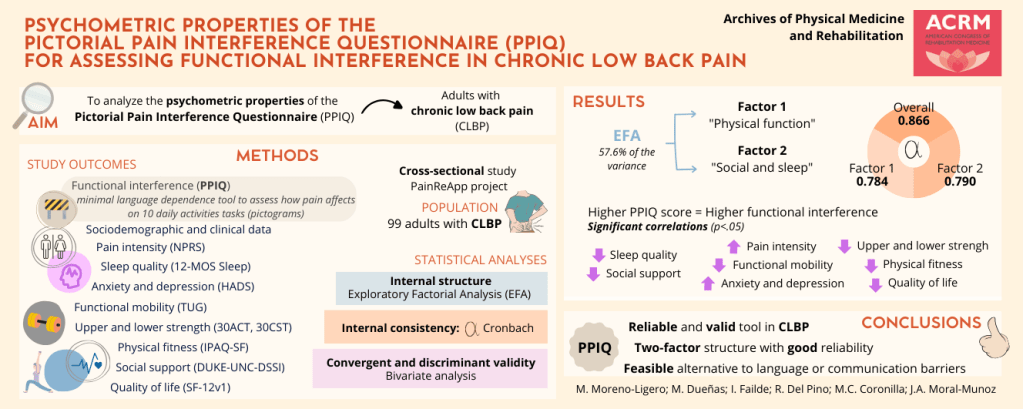
Among the measurement results collected, the functional interference caused by pain was evaluated with the Pictorial Pain Interference Questionnaire (PPIQ), developed and validated in a population with chronic pain. It is a minimally language-dependent questionnaire, which includes 10 illustrations representing activities of daily living, such as walking, climbing stairs, or socializing. Each item is scored from 1 (“no or very little interference”) to 5 (“great interference”), according to how much pain interferes with performing these activities.
The exploratory factor analysis of the questionnaire showed two factors, one encompassing the items more related to physical functionality (“Physical Function”), and the other with social activities and sleep quality (“Social and Sleep”). Likewise, excellent and good internal consistency was observed for the overall score of the Pictorial Pain Interference Questionnaire and both factors, respectively. The convergent and divergent validity with the rest of the variables (pain intensity, quality of life, anxiety and depression, social support, functionality, among others) were almost entirely significant.
Therefore, the PPIQ is a valid instrument with good psychometric properties and appears to be a feasible alternative for measuring functional interference in patients with chronic low back pain when there are linguistic or communication barriers.
You can read the full article at the following link: DOI: 10.1016/j.apmr.2024.05.029
About Author